Procure-to-Pay software : what is the best solution for 2027 ?
Oxalys, Coupa, SAP Ariba, Ivalua, Basware, Medius, Esker: comparison of the 7 best Procure-to-Pay software solutions, selection criteria, questions to ask during a demo and the right solution for each profile.
Reading time : 11 min
Updated on : 04 november 2026

Brayan : Digital Marketer
The best Procure-to-Pay software is the one that covers the entire procurement cycle, from purchase request to supplier payment, with no re-keying and at a cost suited to your size. Oxalys is the most complete solution for French mid-sized companies, SMEs and public organisations. Coupa and SAP Ariba mainly target large international groups, Ivalua large enterprises with complex processes, and Basware, Medius and Esker supplier invoice automation.
The e-invoicing reform has put the subject back on the agenda: receiving electronic invoices is not enough, you still need to match them automatically with orders and receipts. Here is our comparison, our criteria and the right solution for each profile.
🔎 Transparency: this article is published by Oxalys, the publisher of one of the solutions compared. The other solutions are described based on public information from their publishers.
In short ✅
- Best P2P software for mid-sized companies, SMEs and the public sector : Oxalys, a modular French suite, from order to payment.
- For large international groups : Coupa or SAP Ariba.
- For complex, highly configurable procurement : Ivalua.
- To automate supplier invoices first : Basware, Medius or Esker.
- The trap to avoid : choosing an invoice processing tool thinking you are buying complete P2P software.
- The deciding criterion : automatic order / receipt / invoice matching.
What is Procure-to-Pay software?
A Procure-to-Pay (P2P) software automates the entire purchase-to-payment cycle in a single tool : purchase request, approval, order, receipt, invoice control and payment. It replaces e-mails, Excel files and re-keying with a single, traceable flow. It is also called Purchase-to-Pay software.
The 6-step P2P cycle :
- Purchase request : the employee expresses their need, often from a catalogue.
- Approval : the approval workflow checks the budget and the procurement policy.
- Order : the purchase order is sent to the supplier.
- Receipt : the quantities delivered are recorded.
- Invoice control : the invoice is matched with the order and the receipt (three-way matching).
- Payment : the compliant invoice goes to payment and the accounting entry is generated.
Not to be confused with Source-to-Pay (S2P), which adds sourcing, tenders and contract management upstream.
How to choose the best Procure-to-Pay software: the 7 criteria
The best P2P software is not the best known, it is the one that fits your organisation. Here are the 7 criteria to check before signing.
- Full cycle coverage : purchase request, order, receipt, invoice and payment in the same tool. A tool limited to invoices leaves everything upstream in Excel.
- Automatic three-way matching : order, receipt and invoice compared automatically, with tolerance thresholds. This is the criterion that saves the most time.
- E-invoicing compliance : receipt of Factur-X, UBL and CII formats via an approved platform.
- Integration with your ERP : retrieval of suppliers, items and entries with no double entry.
- User adoption : catalogues and punch-out, mobile approval, a simple interface for occasional requesters.
- Supplier portal : your suppliers view their orders, invoices and payments, which reduces chasers.
- Total cost and deployment time : subscription, integration, training, and a realistic timeframe before the first gains.
Depending on your sector, add an 8th criterion: multi-site, public procurement or inventory management.
Our method: how we compared Procure-to-Pay software
We assessed each solution against the 7 criteria above, based on information published by the publishers and our knowledge of the procurement market in France. We deliberately chose solutions with different profiles:
- complete P2P suites, covering procurement from request to payment (Oxalys) ;
- Source-to-Pay suites designed for large groups (Coupa, SAP Ariba, Ivalua);
- invoice processing specialists, starting from accounts payable (Basware, Medius, Esker).
The ranking reflects the fit with each company profile, not an absolute score: software that is perfect for an international group may be oversized for a mid-sized company.
Comparison of the best Procure-to-Pay software
Oxalys comes out on top for French mid-sized companies, SMEs and public organisations : it is the only solution in the comparison that is French, modular and focused on the full P2P cycle.
🔎 This table compares the publishers’ public positioning. Always check the functional coverage on your own case during a demo.
Comparing Procure-to-Pay software?
Test Oxalys on your own processes: purchase request, order, receipt and an invoice with discrepancies.
Request a demo
The 7 best Procure-to-Pay software solutions in detail
1. Oxalys: the best Procure-to-Pay software for mid-sized companies, SMEs and public organisations
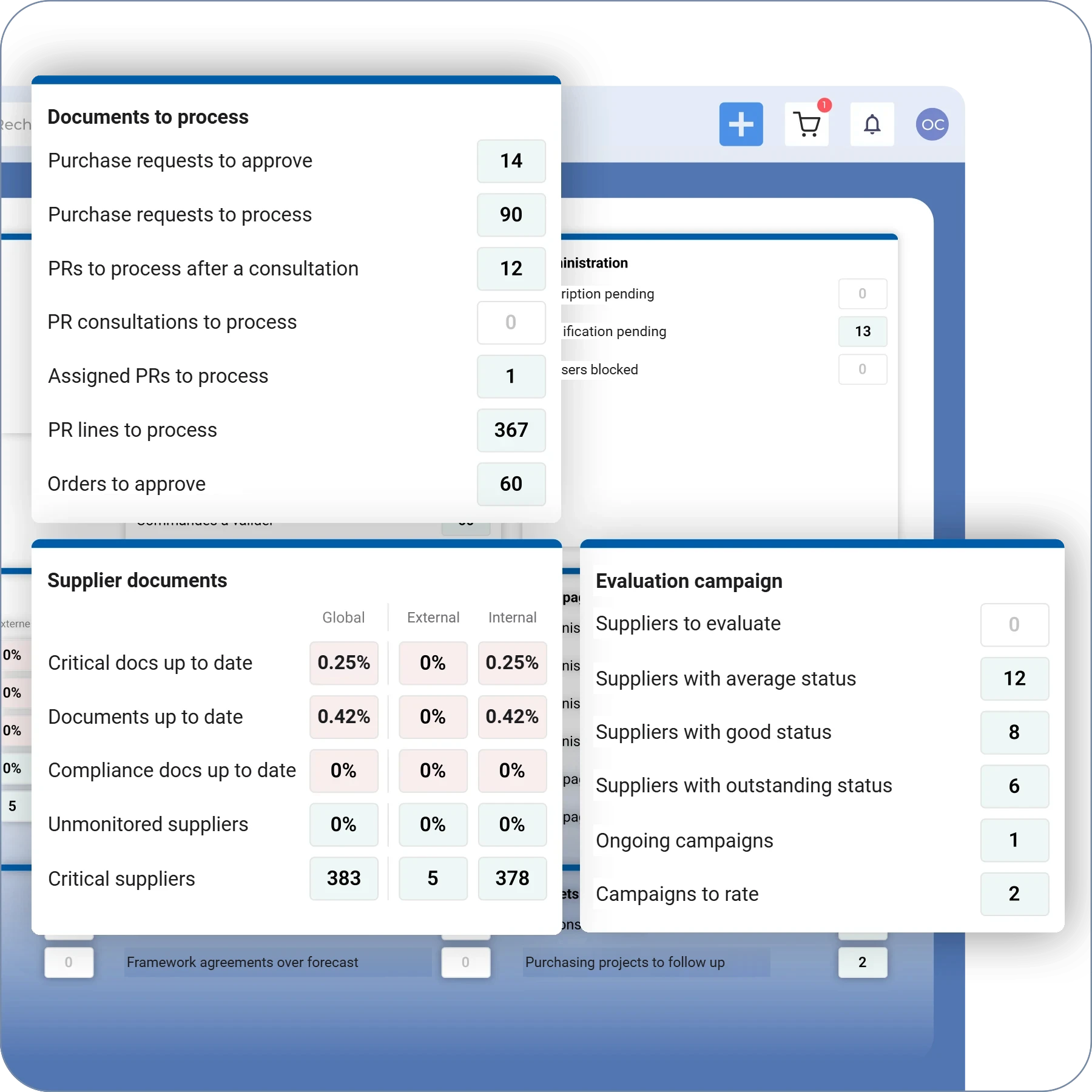
Oxalys is a French procurement software publisher, used by more than 50,000 professionals in the public and private sectors. Its Procure-to-Pay solution covers the entire cycle, from purchase request to supplier payment.
- Purchase requests and catalogues : internal catalogues and punch-out to major suppliers (Amazon Business, Lyreco, Manutan, Office Depot, Hoffmann Group…).
- Configurable approval workflows : workflows by amount, budget or purchase category, mobile approval.
- Three-level receipt : announced, counted, accepted.
- Automatic order / receipt / invoice matching : only invoices with discrepancies require intervention.
- Invoices captured via OCR or EDI, management of disputes and payment approvals.
- Calculation of invoices not yet received (accruals) and prepaid expenses.
- Supplier portal, ERP integration and additional modules: sourcing, contracts, supplier relationship and quality.
💡 Points to note : a solution designed for French organisations; a highly international group operating in dozens of countries will also look at global suites.
Ideal for : mid-sized companies, SMEs, multi-site groups and public buyers who want a complete tool, in French, deployed module by module.
“We saved nearly 40% of the time spent on processing supplier invoices.”
Jean-Baptiste Collin, Procurement Manager, F2J Industry 📝
2. Coupa: the spend management platform for large groups
Coupa is an American cloud platform for spend management (Business Spend Management). It covers Source-to-Pay and includes analytics and artificial intelligence features.
- Strengths : global view of spend, supplier network, advanced analytics.
- Points to note : a large-scale project, often oversized for a mid-sized company or an SME.
Ideal for : large international groups with high procurement volumes.
3. SAP Ariba: the benchmark for large enterprises running SAP
SAP Ariba is SAP’s procurement suite. It relies on a vast supplier network and integrates natively with SAP ERP.
- Strengths : continuity with the SAP ecosystem, Source-to-Pay coverage.
- Points to note : less natural outside a SAP environment, long and costly deployment.
Ideal for : large enterprises already running SAP, with international procurement.
4. Ivalua: the configurable Source-to-Pay suite
Ivalua is a French publisher offering a unified Source-to-Pay suite, known for its configurability.
- Strengths : highly flexible configuration, complete Source-to-Pay coverage.
- Points to note : configurability requires extensive set-up and project resources.
Ideal for : large enterprises and public organisations with complex processes and the resources for a large-scale project.
5. Basware: invoice automation at scale
Basware is a Finnish publisher specialising in supplier invoice automation and international e-invoicing.
- Strengths : processing of large volumes, e-invoicing compliance in many countries.
- Points to note : the approach starts from the invoice; upstream steps (purchase requests, orders) are less central.
Ideal for : organisations processing very large volumes of invoices in several countries.
6. Medius: accounts payable automation
Medius is a Swedish publisher focused on accounts payable automation, with P2P features.
- Strengths : automated invoice processing, finance-oriented approach.
- Points to note : designed first for the accounting department rather than for buyers.
Ideal for : accounting departments that want to automate invoice processing first.
7. Esker: document automation for financial processes
Esker is a French publisher that automates document processes, including the processing of supplier invoices and orders.
- Strengths : document digitisation, automation of financial flows.
- Points to note : a document-based approach, less focused on procurement management.
Ideal for : finance departments whose main goal is to digitise their invoices.
Which Procure-to-Pay software should you choose for your profile?
The size of the company and the starting point of the project determine the right choice.
If your invoices are already automated but your orders still go through e-mail, that is a sign you need real P2P software, not just an invoice processing tool. To find out more, discover how Oxalys Procure-to-Pay software digitalises your procurement and how to handle a non-compliant supplier invoice.
What gains can you expect from Procure-to-Pay software?
Well-deployed P2P software acts on four measurable levers :
- Invoice processing time : only invoices with discrepancies require intervention. At F2J Industry, the time spent processing supplier invoices fell by nearly 40%.
- Spend control : every purchase goes through an approved request, which limits off-policy and off-contract purchasing.
- Financial visibility : commitments known in real time, accruals calculated automatically, faster closings.
- Supplier relationships : fewer disputes, payments on time and a portal that reduces chasers.
The 8 questions to ask during a demo
A standard demo always shows the ideal case. To truly compare Procure-to-Pay software, insist on your own scenarios :
✅ Your question checklist
- Demonstrate an invoice with a price discrepancy : how is it detected, and who is alerted?
- How is a partial receipt handled when it is invoiced in full?
- How do Factur-X, UBL and CII invoices arrive via the approved platform?
- What data is synchronised with my ERP, and in which direction?
- How does an occasional requester place an order from a catalogue?
- Can I change an approval workflow without calling on the publisher?
- What does my supplier see in the portal: orders, invoices, payment status?
- What is the realistic timeframe before the first order is placed in the tool?
The 5 steps to deploy Procure-to-Pay software
- Map your current flows : order and invoice volumes, approval workflows, tools in place.
- Prioritise an initial scope : often purchase requests and orders, where discrepancies arise.
- Connect the ERP and the approved platform : suppliers, items, entries and electronic invoices.
- Train users by profile : requesters, approvers, buyers, accounting.
- Extend module by module : receipt, invoice matching, supplier portal, then sourcing and contracts.
Conclusion: what is the best Procure-to-Pay software for you?
If you are a mid-sized company, SME or public organisation, Oxalys is the best Procure-to-Pay software for you. It covers the full cycle with modular deployment and automatic invoice matching. For a large international group, Coupa or SAP Ariba are the obvious choices.
Before choosing, test the solution on your own cases : a purchase request, an order, a partial receipt and an invoice with discrepancies.
Compare for yourself
See Oxalys on your own procurement processes. 30 minutes with an expert.
Request a demo
Contents 📝

How to choose the best Procure-to-Pay software?💡
What is the best Procure-to-Pay software in France?
For mid-sized companies, SMEs and public organisations, Oxalys is the most complete P2P software : it covers the entire cycle, from purchase request to payment. Large international groups tend to turn to Coupa or SAP Ariba.
What is the difference between Procure-to-Pay and Source-to-Pay?
The Procure-to-Pay covers operational purchasing, from request to payment. Source-to-Pay adds sourcing, tenders and contract management.
How much does Procure-to-Pay software cost?
The price depends on the number of users, modules and integrations. It generally consists of an annual subscription and deployment fees. Request a demo to get a tailored quote.
Is P2P software useful with e-invoicing?
Yes. The approved platform transmits electronic invoices, but only P2P software matches them automatically with orders and receipts before payment. We chose AGENA3000 to handle this connection.
How long does it take to deploy Procure-to-Pay software?
It depends on the scope and the integrations. A module-by-module deployment, starting with purchase requests and orders, delivers the first gains quickly.
What is the best P2P software for an SME?
An SME needs software that is easy to deploy, modular and in its own language, covering purchase requests, orders and invoices without a heavy project. Oxalys meets this need; suites for large groups, such as Coupa or SAP Ariba, are often oversized for an SME.
What is the difference between P2P software and invoice management software?
Invoice management software processes invoices once they are received. P2P software covers the entire upstream cycle : purchase request, approval, order and receipt. This is what allows it to match each invoice with an order and a receipt.
Is there free Procure-to-Pay software?
There is no real free P2P software for businesses. Spreadsheets and basic ERP modules let you get started, but with no approval workflow, no automatic matching and no supplier portal.
Similar articles

More than 50,000 professionals have already adopted Oxalys. Discover how to transform your procurement processes every day.
Oxalys is your 100% customisable procurement management solution that evolves with your business.