Procurement optimization : 8 levers to cut costs and secure your supply chain
Procurement optimisation : discover 8 practical levers to cut costs, secure your supply chain and manage the performance of your procurement.
Reading time : 11 min
Updated on : 5 November 2026

Stéphanie : Procurement expert
Price volatility, supply tensions, pressure on margins : every euro spent with a supplier counts. Procurement optimization is not just about negotiating prices. It starts with a clear view of your spend : what you buy, from which suppliers and on what terms ? This knowledge lets you activate the right levers to cut costs and secure your supply. Discover 8 procurement optimization levers to put into practice with Oxalys.
4 key takeaways ✅
- Procurement optimization pursues three goals: cutting costs, managing risk and creating value.
- It follows a 4-step method : spend analysis, segmentation, category strategy, action plan.
- 8 levers turn the strategy into action, from centralising orders to digitalisation.
- Without reliable data and control all the way to the invoice, negotiated savings remain theoretical.
What is procurement optimization?
Procurement optimization refers to all the initiatives that aim to reduce purchasing costs, secure supply and create value through structured management methods and the right procurement solutions.
The 4 types of purchases to optimise
4 main categories of purchases can be optimised, each with its own levers:
- Direct purchases (raw materials, components), which affect the cost price,
- Indirect purchases (supplies, IT, general services), often scattered and rarely covered by contracts,
- Capital expenditure (equipment, machinery), to be assessed over its whole lifetime,
- Services and subcontracting, whose quality depends on how suppliers are managed.
The goals: cut costs, manage risk, create value
Cutting costs is the most visible goal of procurement optimization. To make the gains last, you also need to manage the risks of supply disruption, dependency and non-compliance, while creating value: supplier innovation, quality or a CSR contribution. A formalised procurement strategy helps you balance these goals for each purchasing category.
📌 Key takeaway
Optimising procurement is first and foremost about balancing cost, risk and value, with levers suited to each type of purchase.
How to optimize procurement in 4 steps?
The approach follows 4 steps: understand where the money goes, segment your purchases according to what is at stake, define a strategy for each category, then roll out the actions and measure the results.
Analyse your spend (spend analysis)
Spend analysis consolidates order, invoice and contract data, then classifies it by supplier, category and entity. Its main purpose is to uncover savings opportunities : duplicate suppliers, different prices for the same item, off-contract spend…
Segment your purchases with the Kraljic matrix
Introduced by Peter Kraljic in the Harvard Business Review in 1983, this matrix compares a purchase’s impact on profit with its supply risk :
📌 Key takeaway
A solid diagnosis lets you focus your efforts on the purchases with real optimisation potential.
Define a strategy for each purchasing category
Each purchasing category has its own goals, levers and a supplier relationship suited to its quadrant. Leverage purchases lend themselves to competitive tendering ; strategic purchases call for long-term management.
Roll out and track an action plan
The procurement action plan turns the strategy into concrete actions. For each one, set a deadline, an owner, the resources required, the expected gain and a tracking indicator. Regular reviews let you adjust course.
Do you know exactly where your money goes?
Oxalys consolidates all your spend by supplier, category and entity. Identify your first savings opportunities in just a few clicks.
Analyse my spend with Oxalys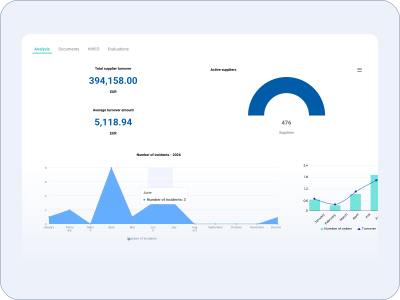
8 procurement optimization levers
1. Centralise and standardise orders
Centralising requests in a single channel, with approved catalogues and approval workflows, reduces order fragmentation and processing costs. This first lever is organisational: it relies on shared processes and master data.
2. Pool volumes across sites and entities
In multi-site organisations, negotiations are sometimes siloed. Grouping the needs of different sites or subsidiaries strengthens your negotiating power and lets you replace local agreements with group-wide contracts. This pooling requires a consolidated view of spend and harmonised naming rules.
3. Renegotiate contracts and payment terms
Prices, discounts, price revisions, penalties : every clause can be renegotiated when it falls due. So can payment terms: in France, they are capped at 60 days from the invoice date, or 45 days end of month if the contract provides for it (French Commercial Code, art. L441-10). Rigorous supplier contract management avoids unwanted tacit renewals.
4. Think in terms of total cost of ownership (TCO)
The TCO (Total Cost of Ownership)adds to the purchase price the costs of logistics, storage, maintenance, poor quality and end of life. It lets you calculate the real cost of owning a product or service. Formalised by Lisa Ellram (1995) in particular and very common in the software industry, this approach avoids choosing an offer that, although cheaper to buy, turns out to be more expensive to use.
5. Rationalise your supplier panel
A supplier panel that is too large scatters volumes and makes monitoring harder. Reduce the number of active suppliers per category to strengthen your negotiating power and make it easier to manage their performance. However, keep alternatives for critical purchases.
6. Tackle off-channel purchasing
Off-contract or off-process purchases (maverick buying) lose the benefit of negotiated terms. They may result from an unintentional slip or a deliberate workaround. To reduce them, address their causes rather than adding more controls.
7. Anticipate supplier risks
Financial failure, supply disruption, non-compliance : a risk score fed by internal data (delays, non-conformities) and external data (creditworthiness, legal documents) helps you prioritise your actions.
8. Digitalise the procurement process
A procurement solution connects sourcing, contracts, orders and invoices in a single flow. Negotiated prices apply automatically and every expense is tracked. In France, since 1 September 2026, all companies must also be able to receive electronic invoices (economie.gouv.fr), one more reason to digitalise the Procure-to-Pay process.
📌 Key takeaway
The most profitable levers combine a price effect (negotiation, pooling, TCO) and a discipline effect (centralisation, off-channel purchasing, digitalisation).
Which KPIs measure procurement optimization?
Four families of indicators are enough to manage the approach.
Procurement gains: savings and cost avoidance
Savings measure a real decrease compared with a reference price; cost avoidance measures a contained increase. Only savings reduce the budget: report them separately to the finance department.
Contract coverage rate
It compares spend covered by a contract or framework agreement with total spend. The higher it is, the more secure your negotiated terms are.
Share of spend under management
This indicator measures the share of spend managed or approved by Procurement. It reveals the areas where the function is not yet involved, often indirect purchases.
Supplier performance and risk
On-time in-full rate (OTIF), non-conformity rate, risk score : these indicators check that price gains do not come at the expense of quality or continuity of supply.
📌 Key takeaway
A good procurement dashboard combines financial gains, spend control and supplier performance, with indicators shared with finance.
Make your procurement gains clear to the finance department
With Oxalys, track every saving from negotiation to invoice and present documented results to your CFO.
Track my procurement gains with Oxalys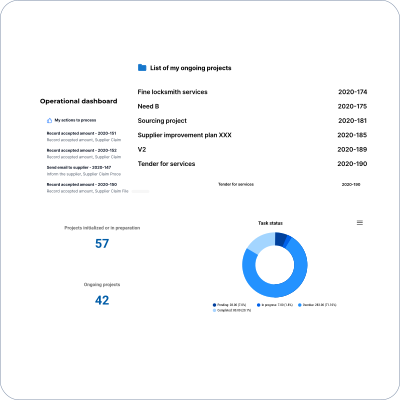
Procurement optimization mistakes to avoid
Focusing only on the purchase price
A low purchase price can hide the costs of poor quality, delays or maintenance. Total cost of ownership and supplier evaluation let you compare offers beyond price alone.
Optimising without reliable spend data
Data scattered across ERPs, spreadsheets and mailboxes makes analysis less reliable and leads to poorly targeted priorities. Before negotiating, consolidate spend and clean up your supplier and item master data.
Neglecting the supplier relationship and dependency
Excessive pressure on a supplier can weaken its financial health and, as a result, your supply. Monitor mutual dependency : your company’s dependency on the supplier, but also the supplier’s dependency on your company.
Measuring savings that are negotiated but never applied
A negotiated price missing from orders remains a theoretical saving. Only checking the gap between negotiated and invoiced prices proves that the gain is real.
📌 Key takeaway
Lasting savings come from reliable data, a balanced supplier relationship and control all the way to the invoice.
Procurement optimization and CSR: a lever for lasting value
Responsible procurement is fully part of an optimisation policy. CSR broadens the analysis beyond the immediate cost to take into account the value created over time.
Include CSR criteria in supplier selection
Carbon footprint, working conditions, ethics, compliance with payment terms : these criteria fit into evaluation grids and tenders. The ISO 20400 standard provides guidelines for structuring a responsible procurement approach.
Reconciling cost reduction and responsible procurement
Cost reduction and responsible procurement often go hand in hand. Eliminating unnecessary volumes, extending the life of equipment and thinking in terms of total cost of ownership help to reduce both spend and environmental impact. Optimisation is therefore measured from the immediate cost to the value created over time.
How does Oxalys support your procurement optimization?
A consolidated view of all your spend
With Oxalys, requests, orders, receipts and invoices feed procurement dashboards updated automatically, by supplier, category, entity or project. You instantly gain visibility over your spend.
Structured tenders and negotiations
The sourcing and tender management module organises RFIs, RFPs and RFQs, centralises the responses and makes multi-criteria comparison of offers easier. You save time while securing the process.
Contracts and negotiated prices applied to every order
Contracts and framework agreements are centralised in a contract repository with expiry alerts. Their link with catalogues and orders lets you apply negotiated prices and maintain a consistent framework throughout the process.
Supplier performance and risk management
The supplier relationship brings together evaluation campaigns, a 360° supplier view and risk scores. This information helps you move beyond day-to-day operational monitoring to truly drive your procurement strategy.
They optimised their procurement with Oxalys
NGE (construction, 17,000 suppliers) brought its catalogues together in a group-wide repository:
“Setting up a group supplier catalogue gave us a global view and let us go beyond local agreements. By connecting Oxalys to our site management solution, we have better day-to-day tracking. »
Bernard Villepinte, Procurement Director, NGE 📝
At NAOS, the solution was adopted by nearly 80% of the users concerned in less than 6 months :
« To support the group’s growth, it became essential to manage our indirect purchases within a single management solution and to develop maximum procurement coverage. »
Stéphane Faustin-Leybach, Group Procurement Director, NAOS 📝
Procurement optimization: a continuous, data-driven process
Optimising procurement is a continuous process : analyse, segment, act, measure, then adjust. What makes the difference is reliable data and tracking gains all the way to the invoice. Built into everyday practice, this approach makes the procurement function a lasting performance lever for the company.
Turn negotiated savings into realised savings
Bring sourcing, contracts, orders and suppliers together on a single platform and explore your savings potential with Oxalys.
Request an Oxalys demo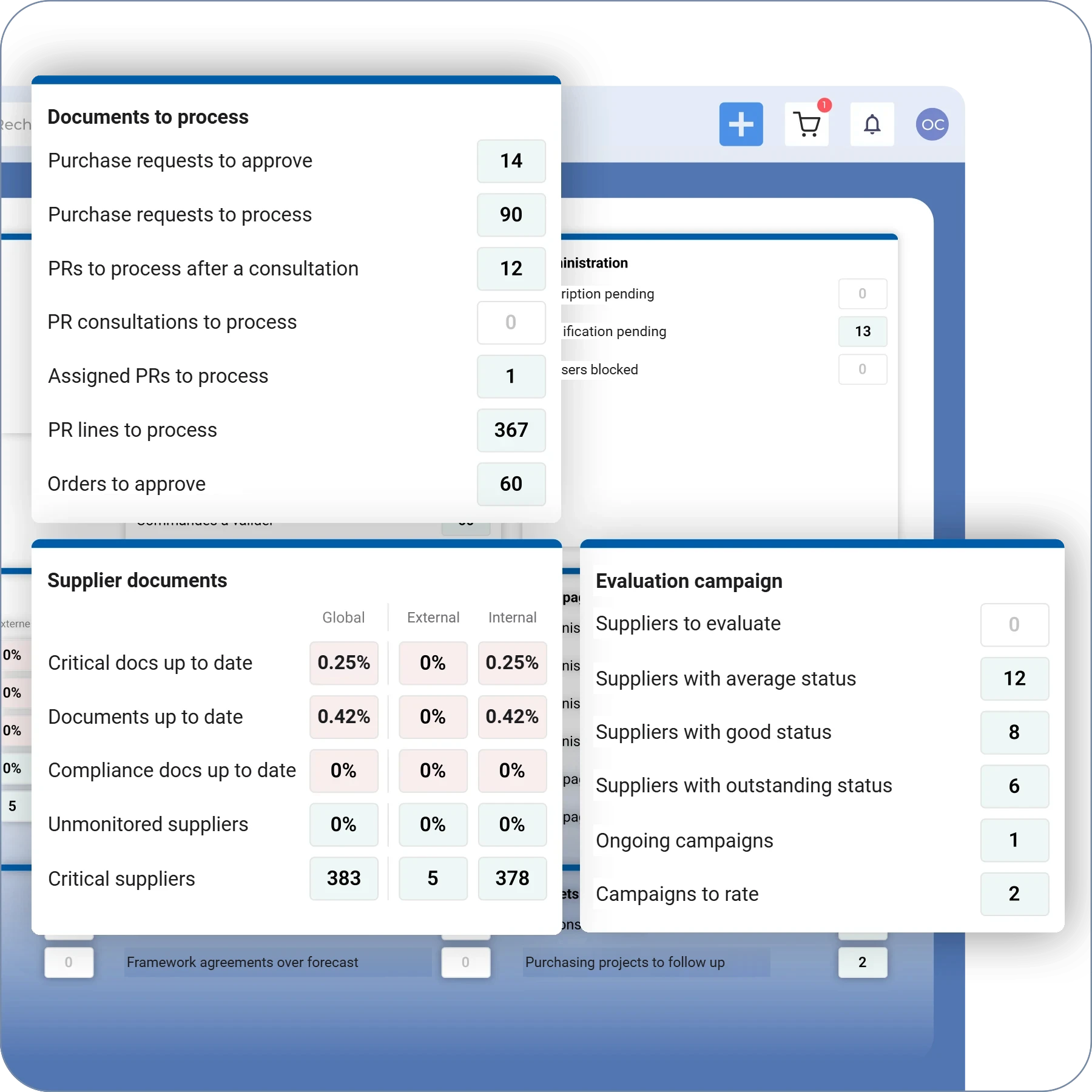
Contents 📝

Procurement optimisation FAQ 💡
How can you improve procurement efficiency?
To improve procurement efficiency, remove manual tasks and make every purchase follow the same channel:
- centralise requests and orders with catalogues and approval workflows,
- automate invoice matching against orders and receipts,
- consolidate spend data to focus buyers on the categories with real savings potential,
- track a few shared indicators such as processing time and spend under management.
How can you reduce long procurement lead times in B2B?
Long lead times usually come from slow internal approvals and poor visibility on supplier capacity. To reduce them, approve requests on mobile, use framework agreements and catalogues for recurring needs, share forecasts with key suppliers and track delivery performance (on-time in-full rate). A supplier portal also speeds up order confirmations and delivery updates.
How can you improve the procurement department?
Improving the procurement department means moving buyers from operational tasks to strategic work. Give requesters a simple ordering path, automate repetitive steps, formalise a procurement strategy for each category and share results with finance. Training buyers in negotiation, supplier risk and data analysis completes the approach.
How can you improve and optimise the procurement process?
Start by mapping the current process, from request to payment, and identifying delays, rework and off-contract purchases. Then harmonise the rules (approval thresholds, preferred suppliers), digitalise the steps in a single tool and measure the results. Optimising a process that has not been harmonised first simply automates its weaknesses.
How can you maximise procurement cost savings?
The biggest savings come from combining a price effect and a discipline effect:
- analyse spend to find duplicate suppliers and price differences,
- pool volumes across sites and renegotiate contracts,
- reason in total cost of ownership rather than purchase price,
- make sure negotiated prices are applied on every order and invoice.
Without control all the way to the invoice, negotiated savings remain theoretical.
How can you improve procurement data?
Reliable procurement data starts with clean master data: one supplier record per supplier, harmonised item and category names, and a single source for orders and invoices. Capturing every purchase in the same tool, rather than in spreadsheets and mailboxes, then feeds procurement dashboards that are updated automatically.
How can you optimise the procure-to-pay cycle?
Optimising the procure-to-pay cycle means connecting every step without re-keying: purchase request, approval, order, receipt, invoice and payment. The key lever is automatic three-way matching between order, receipt and invoice, so that only invoices with discrepancies need attention. A Procure-to-Pay software covers the whole cycle in one flow.
How can you streamline procurement workflows?
To streamline procurement workflows, set approval rules by amount, budget or category and remove unnecessary approval levels. Let approvers validate from their smartphone, send automatic reminders and give everyone real-time visibility on the status of each request. Configurable approval workflows avoid bottlenecks without losing control.
What are procurement costs?
Procurement costs include the purchase price and all the costs of buying: processing requests and orders, receiving goods, checking and paying invoices, logistics and storage, as well as the cost of poor quality, delays and disputes. Total cost of ownership adds maintenance and end-of-life costs to give the real cost of a purchase.
What widens the gap between ambition and agility in procurement?
The gap usually comes from ambitious objectives running on manual processes: savings and CSR targets are set, but data is scattered, approvals are slow and tools do not talk to each other. Reliable data, digitalised processes and a shared roadmap with finance and operations help procurement deliver its ambitions and react quickly.
How can outsourcing optimise procurement spend?
Outsourcing can optimise spend on non-strategic or low-value categories, often called tail spend, by relying on a provider or a purchasing group that already has negotiated terms. It frees buyers for strategic categories. Keep control of contracts, performance and supplier data, and avoid outsourcing critical or strategic purchases.
How can a school optimise its procurement process?
A school can optimise its procurement by grouping recurring needs (supplies, IT equipment, catering, maintenance), using framework agreements and catalogues, and setting clear approval rules for staff. Public schools must also follow the public procurement rules that apply to them. The Procurement Software Oxalys provides traceability and budget tracking.
How can you make better procurement decisions to save money?
Better procurement decisions rely on consolidated data and clear criteria. Compare offers on total cost of ownership, quality and supplier risk rather than price alone, use the Kraljic matrix to choose the right strategy for each category, and check past supplier performance before awarding a contract.
How do procurement optimisation solutions support several departments?
A procurement optimisation solution gives each department the view it needs: requesters order from catalogues, managers approve on mobile, buyers run tenders and manage suppliers, and finance tracks commitments, invoices and accruals. Everyone works on the same data, which removes re-keying and email chasing between teams.
Who can help optimise the procurement process?
Several players can help: the procurement team, which leads the approach, finance and IT, which secure budgets and integrations, procurement consultants for diagnosis and change management, and software publishers such as Oxalys, which digitalise the process from sourcing to payment and support the rollout.
Similar articles


More than 50,000 professionals have already adopted Oxalys. Discover how to transform your procurement processes every day.
Oxalys is your 100% customisable procurement management solution that evolves with your business.