Supplier assessment workflow: the 7-step process to evaluate and approve suppliers
From risk tiering to weighted scoring and reassessment: a practical workflow, a scorecard template and the regulations to know in France, the UK and the US.
Reading time : 12 min
Updated on : 20 November 2026

Brayan : Digital Marketer
A supplier assessment workflow is the structured, repeatable sequence of steps a company follows to evaluate a supplier before onboarding it and throughout the relationship: trigger, risk segmentation, data and document collection, verification, weighted scoring, approval decision, then continuous monitoring and reassessment.
Without a formal workflow, assessments depend on who runs them: one buyer sends a spreadsheet, another forgets the insurance certificate, quality is consulted too late and nobody knows when the next review is due. A documented, tool-supported workflow turns supplier assessment into an auditable process shared by procurement, quality, finance and compliance, whether you buy from France, the United Kingdom or the United States.
5 key takeaways ✅
- A supplier assessment workflow has 7 steps: trigger, segment, collect, verify, score, decide, monitor.
- Risk-based tiering decides how deep each assessment goes and how often it is repeated.
- A weighted scorecard (quality, delivery, cost, risk and compliance, ESG) makes decisions objective and comparable.
- ISO 9001 (clause 8.4) and laws such as Sapin II (France), the Modern Slavery Act (UK) or the UFLPA (US) expect evidence that suppliers are assessed and re-evaluated.
- Automating the workflow in an SRM platform removes chasing, keeps documents valid and gives one view of every supplier.
What is a supplier assessment workflow?
A supplier assessment workflow (also called a supplier evaluation workflow or supplier qualification process) defines who assesses a supplier, on which criteria, with which evidence, in which order and with which decision rules. It covers new suppliers (pre-qualification and onboarding) as well as existing suppliers (periodic re-evaluation and event-driven reviews).
Its output is always the same: a documented decision (approved, approved with conditions, or rejected), a score that can be compared over time and an action plan when gaps are found.
Supplier assessment, evaluation, qualification and audit: what is the difference?
These terms are often used interchangeably, but they cover different moments of the supplier relationship.
📌 Key takeaway
The supplier assessment workflow is the umbrella process: qualification, performance evaluation and audits are steps inside it, triggered according to the supplier’s risk level.
Why formalise your supplier assessment workflow?
A formal workflow is not paperwork for its own sake. It answers four very concrete needs.
- Reduce supply risk: financial failure, quality defects, cyber incidents, sanctions or human-rights violations in your supply chain are detected before they hit production or reputation.
- Prove compliance: ISO 9001 clause 8.4 requires organisations to determine and apply criteria for the evaluation, selection, monitoring of performance and re-evaluation of external providers, and to keep records. Anti-corruption, modern slavery and due diligence laws ask for the same kind of evidence.
- Cut the cost of poor quality: a supplier approved without the right checks generates non-conformities, rework and claims. Tracking the cost of non-conformance by supplier shows how much a weak assessment really costs.
- Make decisions consistent: the same criteria, weights and thresholds apply to every supplier, whoever the buyer and whatever the site or country.
The 7-step supplier assessment workflow
Here is the workflow used by procurement and quality teams in industrial, public and service organisations. Each step has a clear owner, an input and an output, which makes it easy to automate.
- 1TriggerNew supplier, new scope, scheduled review or incident opens an assessment case
- 2SegmentAssign a risk and criticality tier that sets the depth of the assessment
- 3CollectQuestionnaire, documents and certificates gathered through a supplier portal
- 4VerifyScreening, document validation, technical review and audit when needed
- 5ScoreWeighted scorecard: quality, delivery, cost, risk and compliance, ESG
- 6DecideApproved, approved with plan, conditional or rejected, via the approval matrix
- 7MonitorKPIs, alerts and scheduled reassessment that restart the cycle
Step 1: Trigger the assessment
An assessment always starts with an event. Defining these triggers in advance is what makes the workflow systematic instead of ad hoc:
- a new supplier request from a buyer or an operational team,
- a new product, site or category for an existing supplier,
- a scheduled re-evaluation (yearly, every two years…),
- an event: serious non-conformity, late deliveries, change of ownership, negative press, expired certificate.
Output: an assessment case opened in your system, with the supplier, the scope (categories, sites, products) and an owner.
Step 2: Segment suppliers by risk and criticality
Not every supplier deserves the same level of scrutiny. A stationery supplier and the single-source supplier of a safety-critical component cannot go through the same process. Tiering combines the business impact of the supplier (spend, criticality of what it supplies, substitutability) with its exposure (country, sector, data access, regulatory risk).
Step 3: Collect data and documents
The supplier provides the information needed to assess it, ideally through a supplier portal rather than by email. A typical request includes:
- company identity: legal entity, registration and tax numbers, ownership, bank details,
- financial information: latest accounts or credit report,
- certificates: ISO 9001, ISO 14001, ISO 45001, sector standards (IATF 16949, EN 9100, ISO 13485…),
- legal and compliance documents: insurance, anti-corruption and code of conduct commitments, sanctions and export control statements,
- ESG information: environmental policy, carbon data, human-rights and modern slavery statements,
- a self-assessment questionnaire adapted to the tier and the category.
Tip: give every document an expiry date. An insurance certificate or a URSSAF attestation that expires silently is one of the most common audit findings.
Step 4: Screen and verify
Declarations are not evidence. Verification combines automated and human checks:
- screening against sanctions and watch lists, adverse media and financial risk scores,
- document validation: authenticity, scope and validity dates of certificates,
- technical review by quality or engineering: samples, first article inspection, process capability,
- a supplier audit (on site or remote) for Tier 1 suppliers or when the questionnaire reveals gaps.
📌 Key takeaway
The depth of steps 3 and 4 must follow the tier defined in step 2. Over-assessing low-risk suppliers wastes time; under-assessing critical ones creates risk.
Step 5: Score the supplier
Scoring turns the collected information into a comparable result. The most robust method is a weighted scorecard: each criterion is rated on the same scale (for example 1 to 5), then multiplied by a weight that reflects its importance for the category.
Example: (4÷5×30%) + (3÷5×25%) + (4÷5×15%) + (5÷5×20%) + (3÷5×10%) = 77 / 100
Weights are not universal: a packaging supplier will weigh delivery more heavily, a software vendor will weigh cybersecurity and data protection, and a raw material supplier exposed to deforestation or forced-labour risk will weigh compliance and ESG. Define one scorecard template per family of purchases rather than one for the whole company.
Step 6: Decide and approve
The score feeds a decision rule agreed in advance, so that two buyers facing the same result reach the same conclusion.
Two rules make this step reliable:
- Knock-out criteria override the score: a supplier on a sanctions list or without mandatory insurance is rejected whatever its total.
- An approval matrix defines who signs off: the buyer for Tier 3, procurement and quality for Tier 2, a supplier committee for Tier 1.
Step 7: Monitor, reassess and improve
Approval is the beginning of the relationship, not the end of the assessment. Continuous monitoring relies on a few indicators fed automatically by your purchasing and quality data:
- on-time in-full (OTIF) delivery rate,
- quality: defect rate (PPM), number and severity of non-conformities,
- responsiveness: time to close corrective actions (CAPA), quality of communication,
- document validity: certificates and attestations up to date,
- risk signals: credit rating changes, adverse media, sanctions updates.
These indicators feed periodic supplier performance evaluation campaigns and trigger an early reassessment when thresholds are crossed. Suppliers that repeatedly fail improvement plans move to phase-out.
📌 Key takeaway
A workflow is closed-loop: monitoring results automatically reopen step 1. This is what auditors look for under ISO 9001 “re-evaluation of external providers”.
Turn this 7-step workflow into a process that runs itself
Oxalys sets up your risk tiers, questionnaires, scorecards and approval circuits. See it applied to your own supplier categories in a 30-minute personalised demo.
Get my personalised demo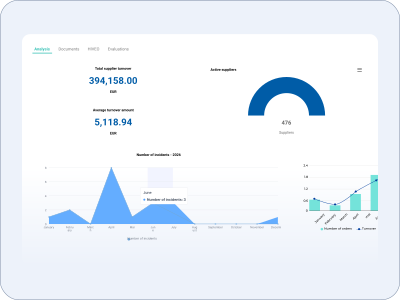
Who does what? A RACI for supplier assessment
Supplier assessment is cross-functional. Clarifying roles avoids the classic situation where procurement approves a supplier that quality has never seen.
R = Responsible, A = Accountable, C = Consulted, I = Informed. The supplier itself is responsible for providing complete and up-to-date information.
Supplier assessment criteria and questionnaire template
A good questionnaire is short for low-risk suppliers and detailed for critical ones. Build it in modules that you activate according to the tier and the category:
- General information: legal entity, group structure, sites, key contacts.
- Financial stability: turnover, profitability, dependency on your business, credit rating.
- Quality management: certifications, quality organisation, traceability, change management, handling of non-conformities.
- Delivery and capacity: production capacity, lead times, business continuity plan, sub-tier suppliers.
- Compliance and ethics: anti-bribery policy, sanctions and export controls, conflicts of interest, data protection (GDPR / UK GDPR).
- Information security: certifications (ISO 27001, SOC 2), access to your data or systems, incident history.
- ESG and human rights: environmental management, greenhouse gas emissions, health and safety, modern slavery and forced-labour controls, responsible sourcing of raw materials.
Each question should be scored, linked to a piece of evidence when it matters, and mapped to one of the scorecard criteria of step 5.
Regulatory requirements in France, the UK and the US
The workflow above is universal, but several laws make parts of it mandatory or strongly expected. Here are the main texts procurement teams should map to their assessment steps.
Duty of Vigilance law (2017): large groups must map and assess risks in their supply chain.
URSSAF vigilance obligation: for contracts of €5,000 or more excluding VAT, obtain the supplier’s vigilance certificate at signature and every six months.Impact on the workflowAnti-corruption questionnaire and screening in steps 3–4; document expiry tracking in step 7
Bribery Act 2010: the “adequate procedures” defence relies on third-party due diligence.
Economic Crime and Corporate Transparency Act 2023: failure-to-prevent-fraud offence for large organisations since 1 September 2025.
Procurement Act 2023 (in force since 24 February 2025): exclusion grounds and debarment list for public contracts.Impact on the workflowHuman-rights and anti-fraud modules in step 3; debarment and sanctions checks in step 4
Uyghur Forced Labor Prevention Act (since June 2022): goods linked to Xinjiang are presumed made with forced labour unless proven otherwise.
Dodd-Frank section 1502: SEC-listed companies report on conflict minerals. Federal contractors must also meet FAR responsibility requirements.Impact on the workflowSub-tier traceability and origin questions in step 3; evidence retained for audits in step 6
EU Deforestation Regulation: applies to large and medium operators from 30 December 2026.
CSRD: sustainability reporting that relies on supplier data.Impact on the workflowRisk-based tiering in step 2; ESG data collection in step 3
This overview is for information only and does not constitute legal advice. Thresholds and dates were checked in November 2026.
📌 Key takeaway
Whatever the country, regulators ask the same question: can you prove that you assessed your suppliers according to their risk, and that you acted on what you found? A traceable workflow is the answer.
Manual vs automated supplier assessment workflow
Many companies still run assessments with spreadsheets, shared folders and email reminders. It works for a few dozen suppliers, then breaks down.
5 common mistakes to avoid
- One questionnaire for everybody: suppliers abandon long, irrelevant forms. Adapt the content to the tier and the category.
- No knock-out criteria: a high average score can hide a disqualifying issue.
- Assessing once and forgetting: without scheduled re-evaluation and event-driven triggers, the approved supplier list goes out of date.
- Procurement working alone: quality, finance and compliance must be involved in the steps where their expertise matters.
- No feedback to suppliers: sharing scores and improvement plans is what turns an assessment into better performance.
How Oxalys automates the supplier assessment workflow
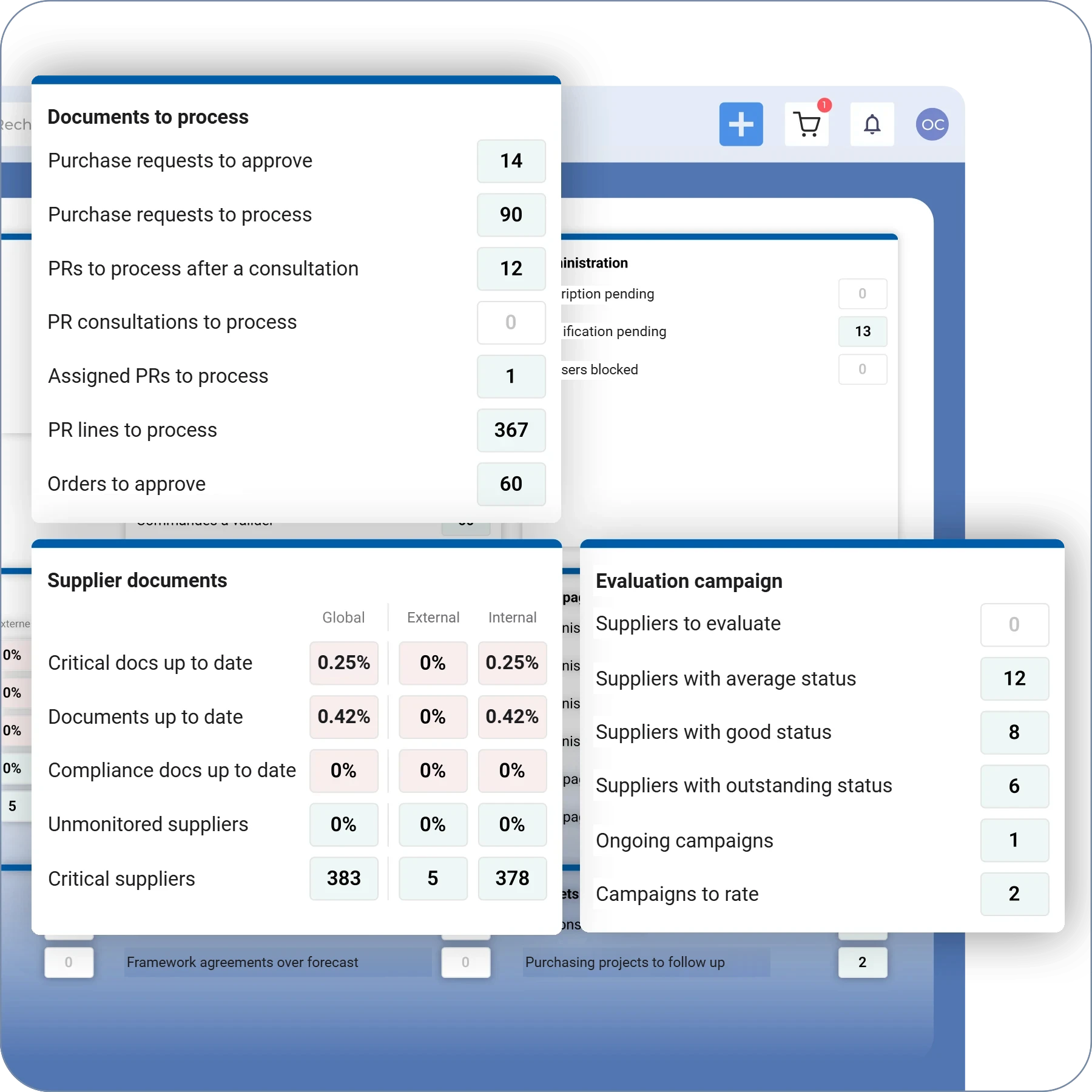
Oxalys Suppliers & Quality Management brings the seven steps together in a single platform used by procurement and quality teams:
- supplier onboarding and qualification by category, site or product, with configurable questionnaires,
- a supplier portal where suppliers update their data and upload documents, with automatic expiry reminders,
- a 360° supplier record that centralises scores, documents, contracts and history,
- performance evaluation campaigns with weighted scorecards and improvement plans,
- supplier audits and non-conformance management that feed the supplier score automatically,
- approval workflows and dashboards to follow every assessment in progress.
The result: fewer emails and spreadsheets, documents that stay valid, and a supplier base you can defend in front of an auditor, a customer or a regulator.
Run every supplier assessment in one workflow
See how Oxalys centralises supplier qualification, scoring, audits and reassessment, with a demo tailored to your suppliers and categories.
Book an Oxalys demo
Contents 📝

Supplier assessment workflow FAQ 💡

What is a supplier assessment workflow?
A supplier assessment workflow is the structured sequence of steps used to evaluate a supplier before and during the relationship: trigger, risk segmentation, data and document collection, verification, weighted scoring, approval decision, then monitoring and reassessment. It makes supplier decisions consistent, traceable and auditable.
What are the steps of a supplier assessment process?
The seven steps are: 1) trigger the assessment, 2) segment the supplier by risk and criticality, 3) collect data and documents, 4) screen and verify, 5) score the supplier with a weighted scorecard, 6) decide and approve, 7) monitor performance and reassess. Step 7 feeds back into step 1.
What criteria should be used to assess a supplier?
The most common criteria are quality, delivery and capacity, cost and financial health, risk and compliance (anti-corruption, sanctions, cybersecurity, insurance) and ESG (environment, human rights, health and safety). Their weights should depend on the category purchased and the supplier’s risk tier.
How often should suppliers be reassessed?
A risk-based frequency works best: every year for critical suppliers, every one to two years for important suppliers and every two to three years for standard suppliers. Any significant event, such as a serious non-conformity, an expired certificate or a change of ownership, should trigger an immediate reassessment.
What is the difference between a supplier assessment and a supplier audit?
A supplier assessment is the overall process of evaluating a supplier, mostly based on questionnaires, documents, data and performance indicators. A supplier audit is one possible step of that process: an on-site or remote verification that the supplier’s processes and evidence match what it declared. Audits are usually reserved for critical or high-risk suppliers.
How do you score a supplier assessment?
Rate each criterion on the same scale (for example 1 to 5), multiply it by its weight, and add the results to get a score out of 100. Then apply decision thresholds, such as approved above 85, approved with an improvement plan between 70 and 84, conditional between 50 and 69 and rejected below 50, with knock-out criteria that lead to rejection whatever the total.
Can a supplier assessment workflow be automated?
Yes. Supplier relationship management (SRM) software such as Oxalys automates questionnaire distribution through a supplier portal, document expiry reminders, weighted scoring, approval circuits, audits and non-conformity tracking, and keeps every assessment and decision in a single supplier record.
Similar articles
More than 50,000 professionals have already adopted Oxalys. Discover how to transform your procurement processes every day.
Oxalys is your 100% customisable procurement management solution that evolves with your business.